
“An intimacy derives from the fact that fanzines remain amateur, ‘handmade’ productions operating outside mainstream publishing conventions and mass-production processes. The hand – the imprint – of the individual producer or maker is readily evident in the fanzine itself. This suggests, then, that the history of the object is bound up not only with the history of fanzines more generally, but also with the history of the individual maker.” – Teal Triggs, Fanzines, 2010. London: Thames & Hudson. Page 206.
Your first assignment asks you to create a small publication or fanzine based on your interest in books and their design. It allows you to introduce yourself, and your interests in book design, so that your tutor can get to know you and your work better.
Your fanzine can be digitally printed, photocopied or handmade. Aim to design a sixteen-page simple folded and stapled A5 fanzine, though you can add more pages, or change the scale, if you want to. You can use any medium or materials to generate your artwork and make your publication. You may want to work much larger and reduce your artwork for the fanzine. While visually it doesn’t have to look like a punk fanzine, try and embrace the lo-fi ‘cut and paste’ attitude, so you’re making the work relatively quickly and not too preciously. Be creative with this task both in terms of the content and how you choose to present it, this could extend to challenging some of the assumptions about what a fanzine should look like, or how it’s made.
Use the work you have produced so far, in the earlier exercises, as a starting point for your content. Not all of this material needs to be included in your fanzine. You may want to develop new visual ideas, or add to the work you have already produced.
As a guide, your fanzine should contain the following elements:
● Introduce yourself – say something about your relationship with books. Why are they important to you? Communicate this through writing and images.
● Your creative process – how do you like to work creatively, what sort of process do you follow to research and generate ideas, and what are your preferred mediums to work in. Say something about you as a creative practitioner and your approach. Show your approach to book design through your design decisions and the hands-on sense of immediacy and energy that is an attribute of fanzine design.
● Looking at books – present the most interesting books you’ve looked at, or those you find influential as a reader, designer or both? Present a selection of books, or focus on one particular example to present in more depth. Think about how you can present these books, and your reflections, in visually engaging ways.
● Global influences – which books with a wide reaching scientific, artistic, historical, political, geographic, fictional, poetic, religious or other impact have you chosen. Present them along with a brief rationale as to why, or how these books have affected you personally. Again, can your designs echo the ideas in these books in anyway?
● The future of the book – where do you see the book heading? Show and tell. Try and summarise your thinking into a series of short statements, quotations, images or ideas. Be creative in how you approach this.
● How can you creatively respond to one or more of following book related sayings – Bookworms, A closed/open book, The oldest trick in the book, You can’t judge a book by its cover, In someone’s good/bad books, or, by the book. Use your fanzine to present your ideas. Can any of your images, text or ideas also feed into your cover designs?
Using your learning log
Keep notes to accompany the making of the publication in your learning log. These notes could cover why you decided to portray what you did, what you included and what you omitted. See it as a way to document and reflect on your creative design process.
Remember that this is an opportunity to experiment with your ideas, so document your creative process, the various stages of your work, and any ideas you rejected along the way. Aim to do this visually by photographing, scanning or taking screenshots of your work in progress and sharing them in your learning log.
As your first book, there’s room to make mistakes, take creative risks and enjoy the creative process, so don’t worry too much about getting it ‘right’. If your visual research takes you away from the above categories, that’s fine, afterall they are just prompts to start the dialogue about your interest in book design.
OCA Book Design 1: Creative Book Design
I was looking forward to this assignment until I have actually properly read the topic. I am going to have some serious trouble if this unit constantly asks for my interests in book design as I am not interested in the topic. I am doing this module as there was no other units available in my Graphic Design pathway, and it means that I had no choice but to do it if I’d like to finish my degree.
That said, I would like to do a good job when it comes to this assignment so I will need to come up with something to inspire myself and be able to put together a decent fanzine.
I started by looking back at all the material that I created during this module so far and see if I can find something that I would be able to use as a starting point.
I found a few pieces that might be enough as a starting point.
I think I can use my observations and text I have produced for Exercise 1: Influential Books , some imagery that I made for the Exercise 2: Future of the book and the images that I made as part of Exercise 3: Alternative Publications.
Hopefully this will give me enough material to work with.
I wanted to look at the different questions that were given as guiding topics and answer them.
Introduce yourself – say something about your relationship with books. Why are they important to you?
Books are not a very important part of my life at all, so this question will be interesting. I will probably just use a bit from my earlier blog on this topic.
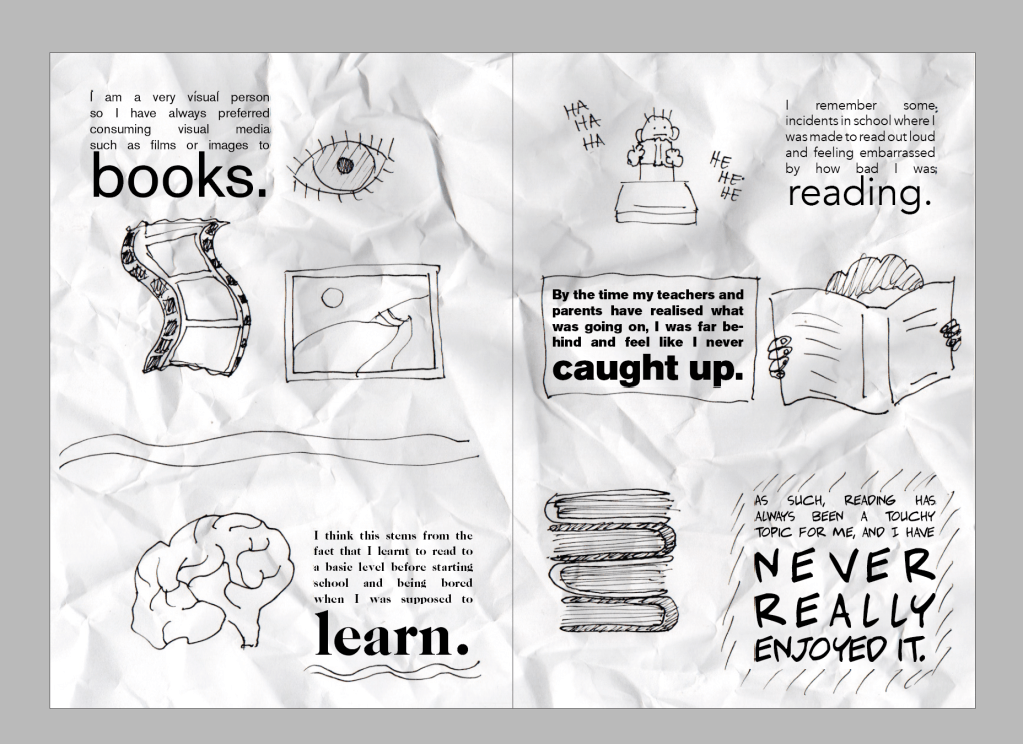
I am a very visual person so I have always preferred consuming visual media such as films or images to books. I think this stems from the fact that I learnt to read to a basic level before starting school and being bored when I was supposed to learn. By the time my teachers and parents have realised what was going on, I was far behind and feel like I never caught up. I remember some incidents in school where I was made to read out loud and feeling embarrassed by how bad I was reading. As such, reading has always been a touchy topic for me, and I have never really enjoyed it.
From my previous blog
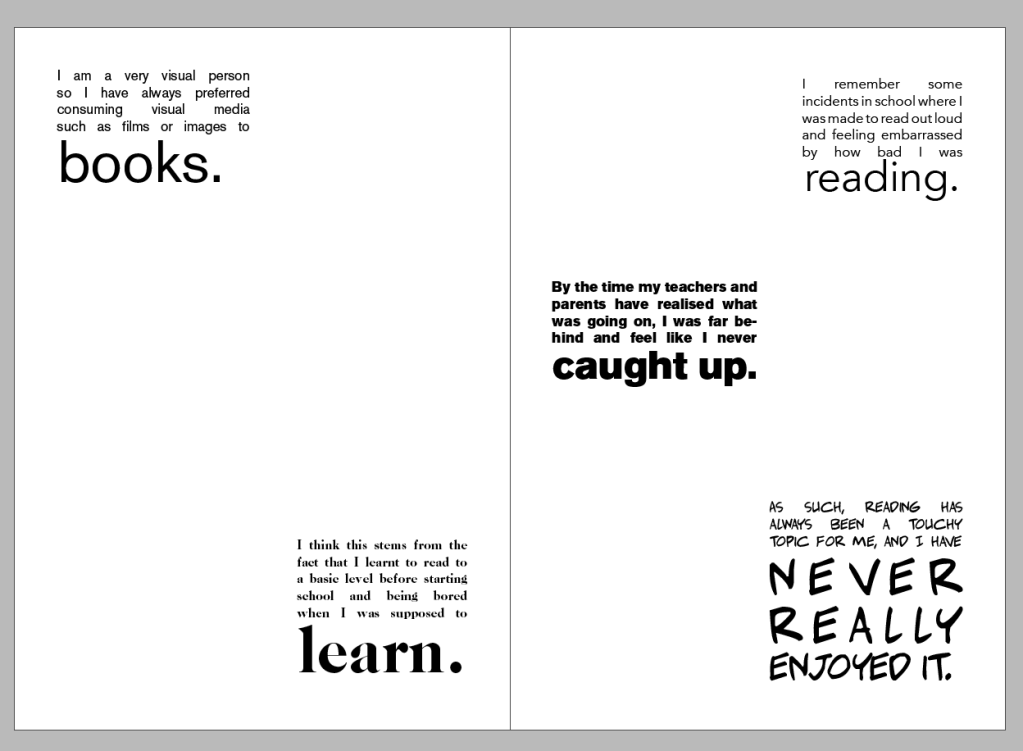
I was thinking that I could add some extra doodles to this to further illustrate my position on the matter. Instead of doing this digitally, I wanted to see if I could do this on paper to add a bit more of the DIY flair to the page.
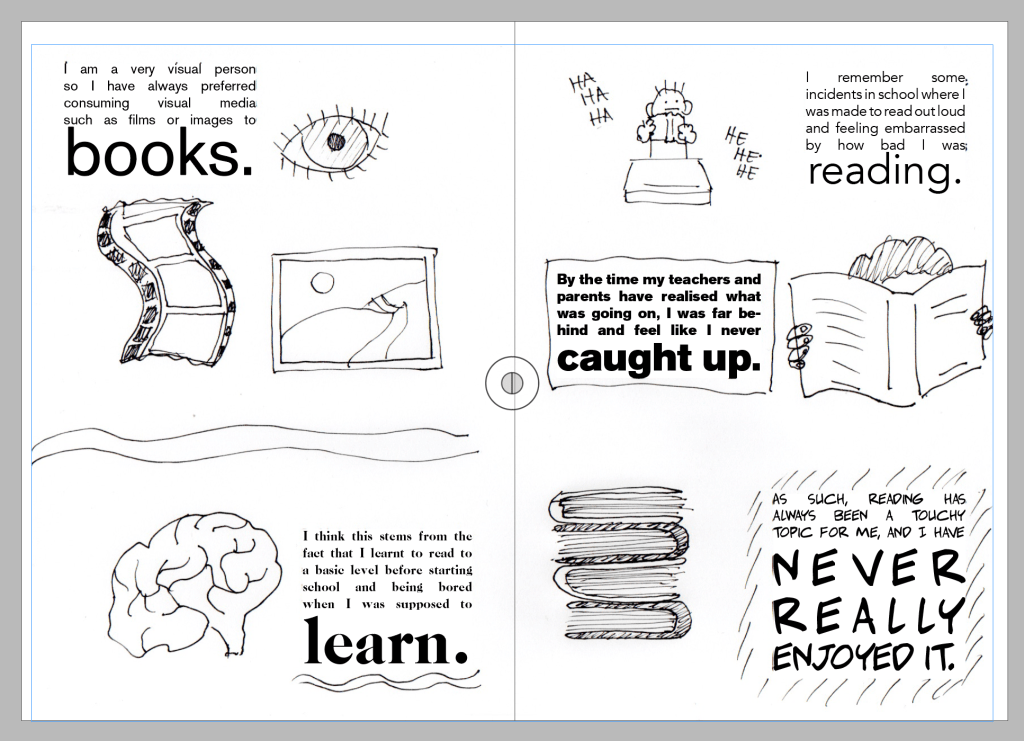
I added some doodles to my printed version and pasted it back into my DTP software.
I think this spread is OK, I can add something more to it as I work on the rest of the pages if I feel like later on.
Updated this section with a background. I crumpled some paper, scanned this and added it over the spread as a texture. I think this represents my frustration with the topic quite nicely.
Your creative process – how do you like to work creatively, what sort of process do you follow to research and generate ideas, and what are your preferred mediums to work in.
My creative process is very all over the place and I am not sure how to describe it. Sometimes I get inspired by the tiniest thing and can start something new without a problem and other times I have to do a lot of thinking before I can start creating. I am a very intuitive creator, so when the muse strikes I can whip up something new very quickly but when I have no inspiration I really struggle.
I have developed a strong methodology during this course and have been able to ease my reliance on sudden inspiration and have been able to work through briefs even when I find them uninspiring.
I usually start by looking at other people’s work before starting to work to get some inspiration and look at parts that I like and see what I would change if I made the piece. This can be a really good starting point to begin exploring my own ideas.
I use google quite a bit to find images and articles relating to my brief and draw further inspiration from this. Mind maps are very useful at this stage to enable lateral thinking. I use mind maps because they enable you to retrace your thoughts and find new ideas this way.
I also use mood boards to collate visual references and ideas. This is also helpful to describe what I have in mind for a particular assignment. This can be an invaluable tool of communication but also enables me to picture different elements of what I am about to create.
Looking at books – present the most interesting books you’ve looked at, or those you find influential as a reader, designer or both? Present a selection of books, or focus on one particular example to present in more depth. Think about how you can present these books, and your reflections, in visually engaging ways.
This is going to be quite difficult, but I think I could create a 2 page spread with some pictures of books that I have around that I enjoy. Not sure if this would be enough for a spread, but I have something in mind.
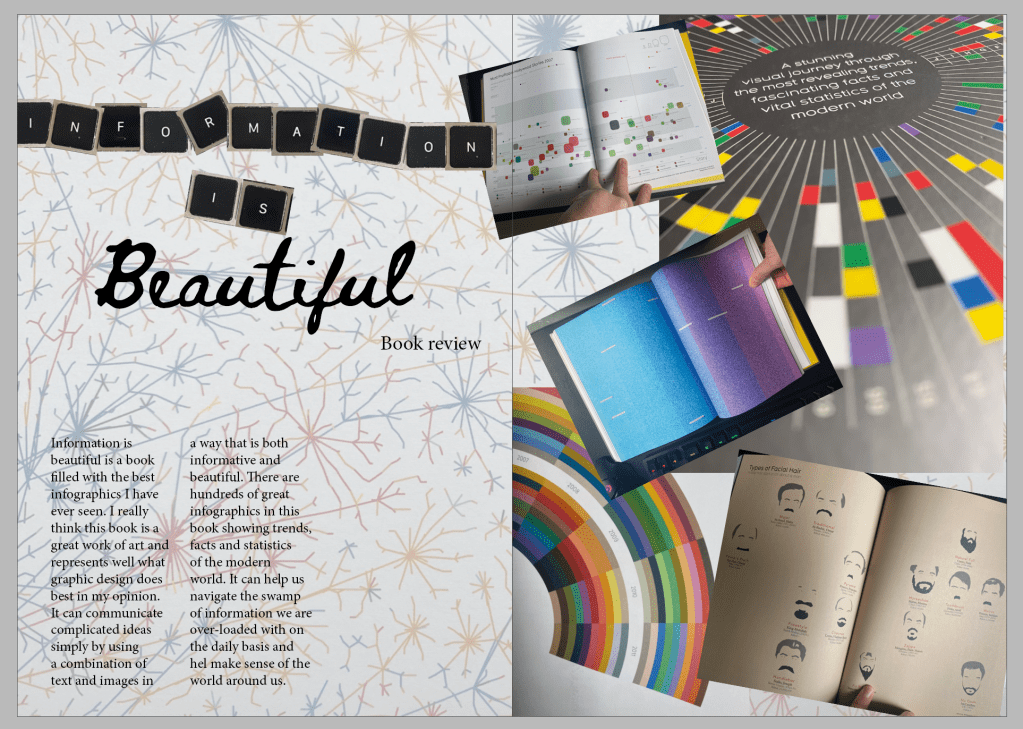
I selected a book that I actually really like. Information is Beautiful by David McCandless. This book is a compilation of some amazing infographics and charts.
I took some pictures of the book and pasted them on the page digitally. I have also took a photo of my keyboard and cropped the image to create some digital cutouts of letters to give that DIY feel. I think this spread turned out pretty well. Can’t wait to see it printed!
Global influences – which books with a wide reaching scientific, artistic, historical, political, geographic, fictional, poetic, religious or other impact have you chosen. Present them along with a brief rationale as to why, or how these books have affected you personally. Again, can your designs echo the ideas in these books in anyway?
I think I will probably need to reach to Harry Potter again. I can’t really think of any book that I have read that has a global influence other than this. I think I will use the research I have carried out in one of the exercises earlier this part.
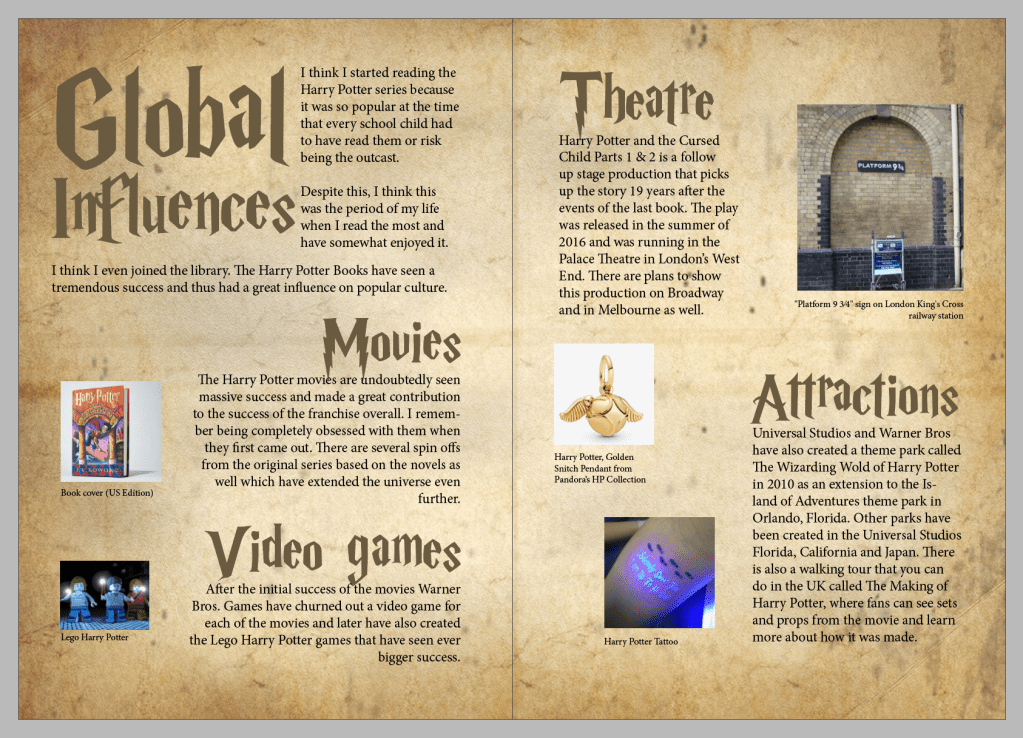
I think the spread turned out well enough, though it is missing a bit of polish. I will probably come back to this and tidy up later.
Sources
- Old paper texture source: https://www.flickr.com/photos/devontt/167285657/
- Font source: https://www.dafont.com/harry-p.font
- https://en.wikipedia.org/wiki/Harry_Potter#Films
The future of the book – where do you see the book heading? Show and tell. Try and summarise your thinking into a series of short statements, quotations, images or ideas. Be creative in how you approach this.
I have written quite a long blog about this topic, so I wanted to use the copy from this and see how it lands itself.
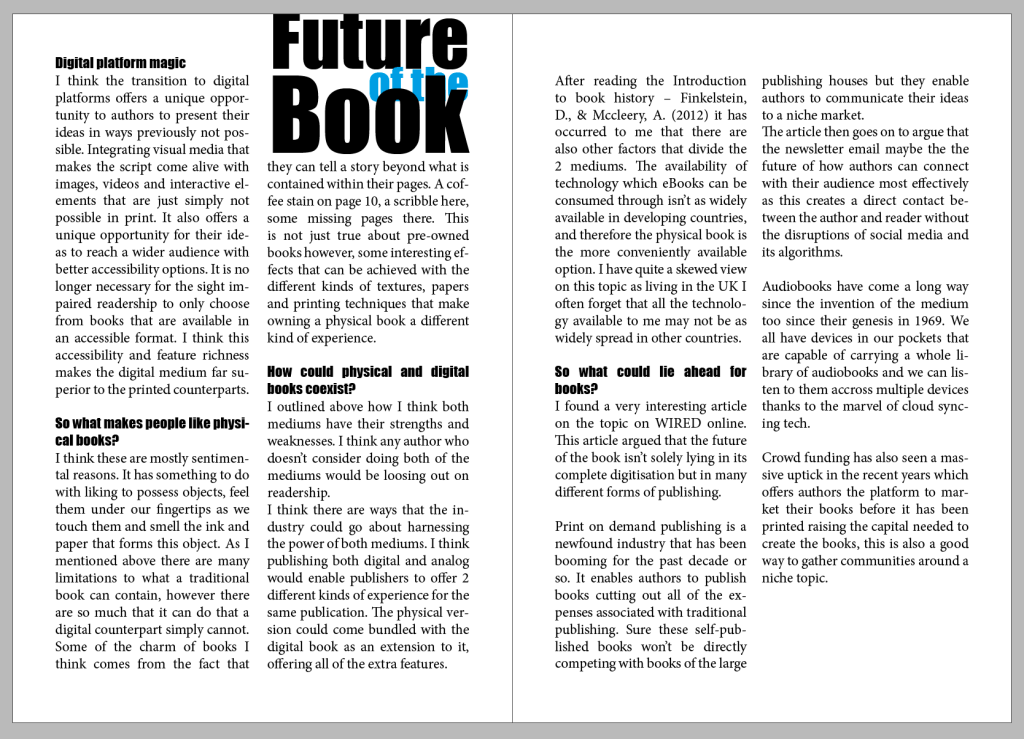
At first glance it looked too boring to be talking about the future of the book. I needed to add some graphical elements that would make this speak more of the content. I remembered that I created something for this exercise that may work for this purpose.
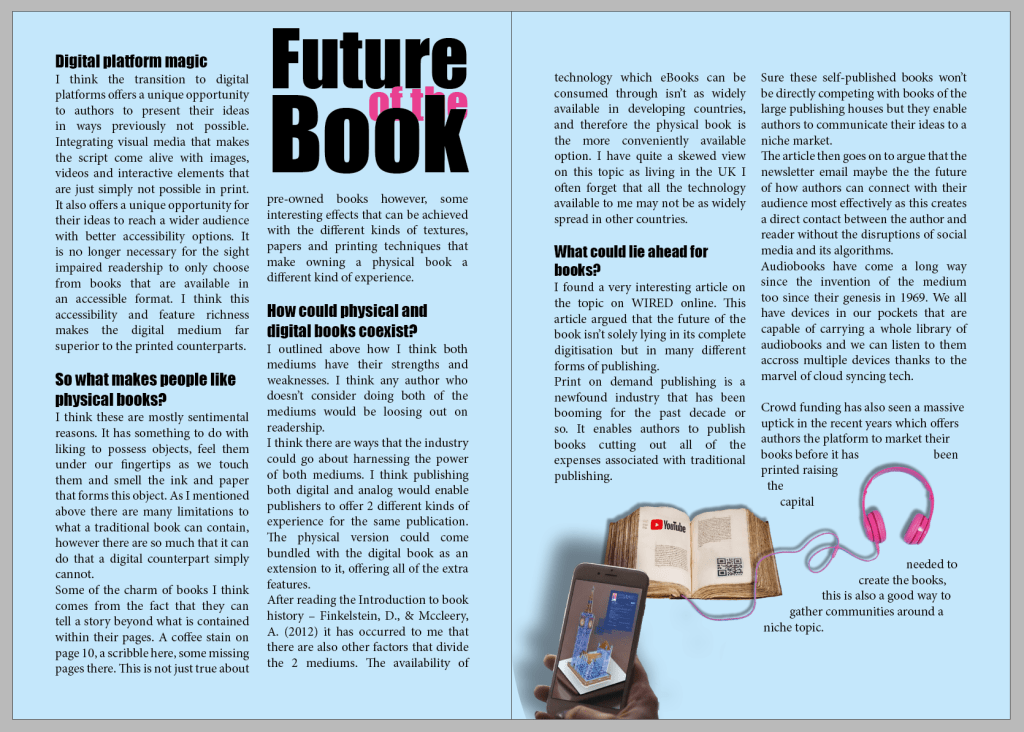
I also added a blue background to the spread to make it a little more interesting. I was also thinking that to work with the topic, I could add a QR code that would enable the reader of my zine to listen to this section as an audiobook.
I found this website that enables you to get your written text to be read out by an AI voice: https://www.naturalreaders.com/online/ I uploaded my article then I uploaded the file here: https://vocaroo.com a platform that enables audio sharing via QR codes.
I think this nicely ties in with the article about the future of the book.
How can you creatively respond to one or more of following book related sayings – Bookworms, A closed/open book, The oldest trick in the book, You can’t judge a book by its cover, In someone’s good/bad books, or, by the book. Use your fanzine to present your ideas. Can any of your images, text or ideas also feed into your cover designs?
For this topic, I thought I could again go back to my blog and see how I would be able to respond using the content that I made for this exercise. Not sure if I written enough to make a double spread, however I am sure I could present the book mockup I made in an interesting manner.
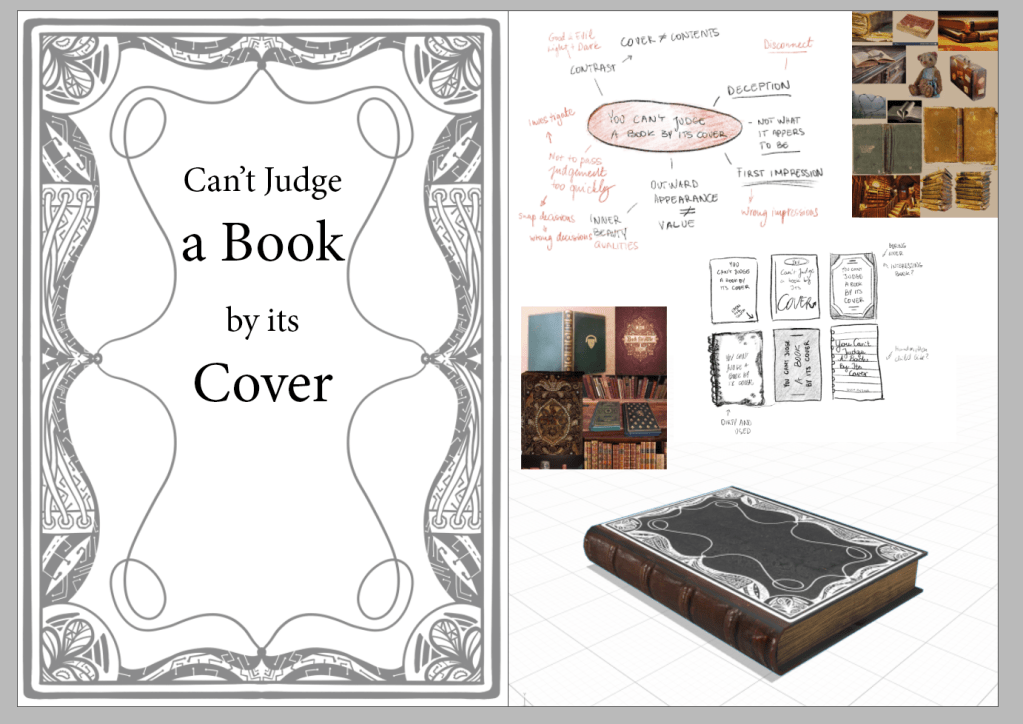
I decided to show off some of the process that of making the book cover for the phrase. I think the layout turned out pretty interesting, but I wasn’t sure what text I could include.
Since the whole zine was 14 pages (including covers at this stage, I decided to add a further 2 page spread to take this to 16 and make it devisable by 4.
Reflections
A fanzine is a fan-made magazine that is usually made out of ones passion for the topic of choice.
I feel like this assignment would have been so much more successful if it wasn’t for the forced topic of books and my passion for them that is non existent. I sincerely hope that later parts of the module will have less of a focus on the topic of love of books, because otherwise I think this will be a real struggle for me to complete this unit.
I feel like my zine is pretty uninspired and definitely not the kind of work I am proud of. I feel like I am a little bit too hung up on the topic and therefore I was not able to enjoy creating the work.
I will try to be a lot more liberal with the topics going forward, and hopefully I can find the spark that I desperately need.
I have learnt a few things throughout the process, playing around with InDesign and trying my hands on booklet making was quite fun.
 Graphic Design