
Firstly, review your visual ideas based on from the previous exercise through a process of critical evaluation. Which ideas are you drawn to? Which ideas have ‘legs’ – possible interesting outcomes which are worth pursuing? Often the ideas which are strongest are those which have depth, or many layers of association. Perhaps you are intuitively drawn to a particular idea. Select a few ideas you would like to push further. Use your learning log to record your thoughts.
Now, do you need to undertake any research to help move your selected ideas on? The form your research will take depends on the individual elements of your idea. Find source material that helps informs your ideas. For example, by doing objective drawings or taking photographs, to understand your subject better, and to consider aspects of composition. You can use both primary and secondary sources of research in this way. Research feeds into the development of your visual work, informing and advancing your ideas. Document this phase of the work accordingly.
The developing your ideas stage is about building on your initial ideas by reworking them, adding the visual or other insights gathered through your research, and testing out different versions or possibilities. Spend 45 minutes developing the possibilities of one of your ideas. How many different ways can you visualise this?
If you want to develop a broader range of ideas, then repeat the previous exercise to generate more possibilities, potentially using a different phrase as a starting point. Use your learning log to document this process of review, research and development.
Visualising your ideas is the culmination of all your preliminary work in which you work up some more developed visual sketches and ideas. This artwork can be hand-drawn illustrations, photographs, and/or include typography. The presentation can be a little rough around the edges but should show the main elements of your designs. Select the strongest variation of your ideas from the previous research and development exercise to start exploring how you can visualise them within a mock-up.
Use your learning log to document these research and development stages, and to reflect on the process and your results.
OCA Book Design 1: Creative Book Design
When I came to this exercise, I realised that in my previous exercise I have not generated enough ideas that I liked to go off, so I wanted to start by revisiting these and perhaps extending on them in advance to come up with some ideas I can properly connect with.
All my new ideas are recorded in red on the below sketches.
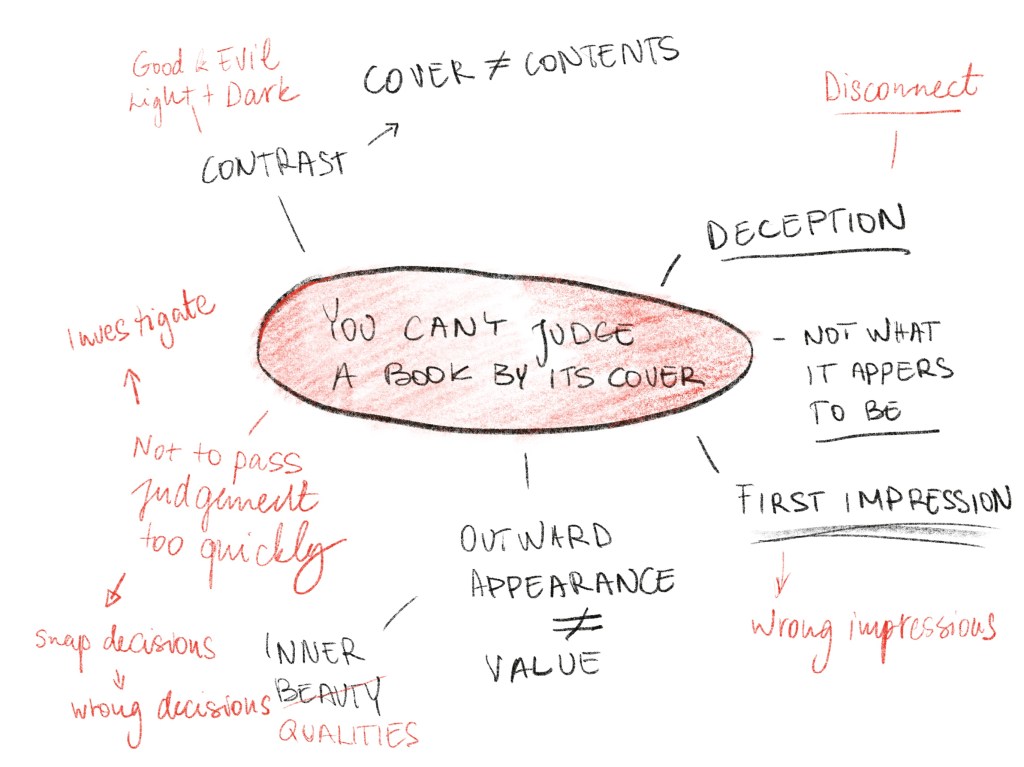
I must say I was really struggling with this. I think this is because the topics were really open ended and could be applied in so many different ways that I was not really able to come up with anything that was making any sense. I looked at my visually generated ideas and I liked number 4 the most.
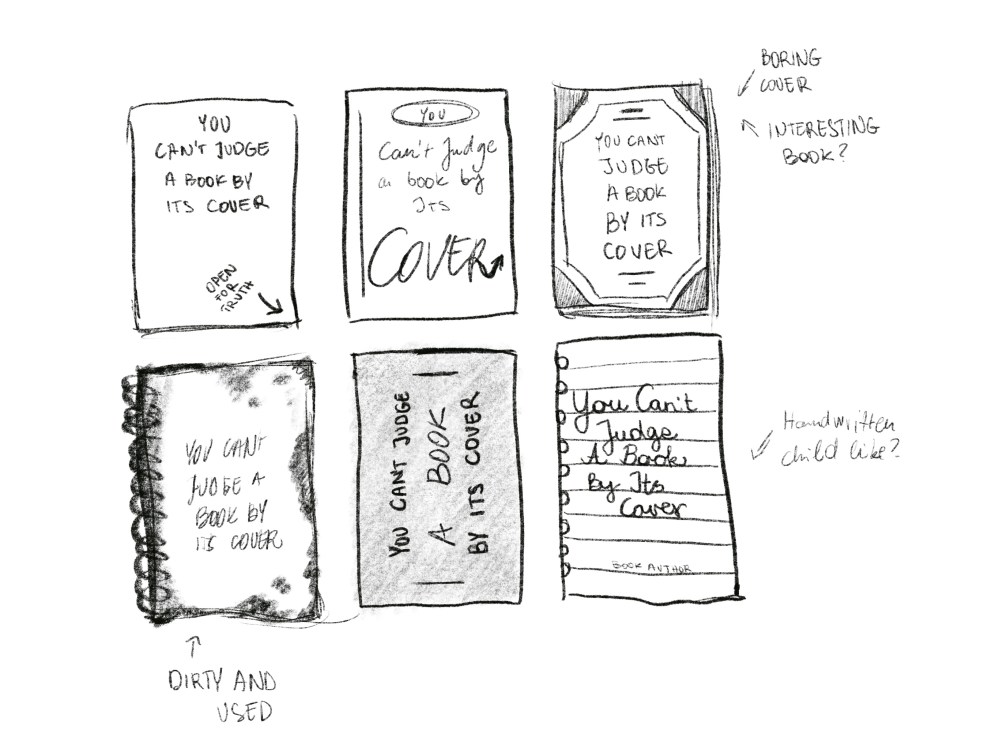
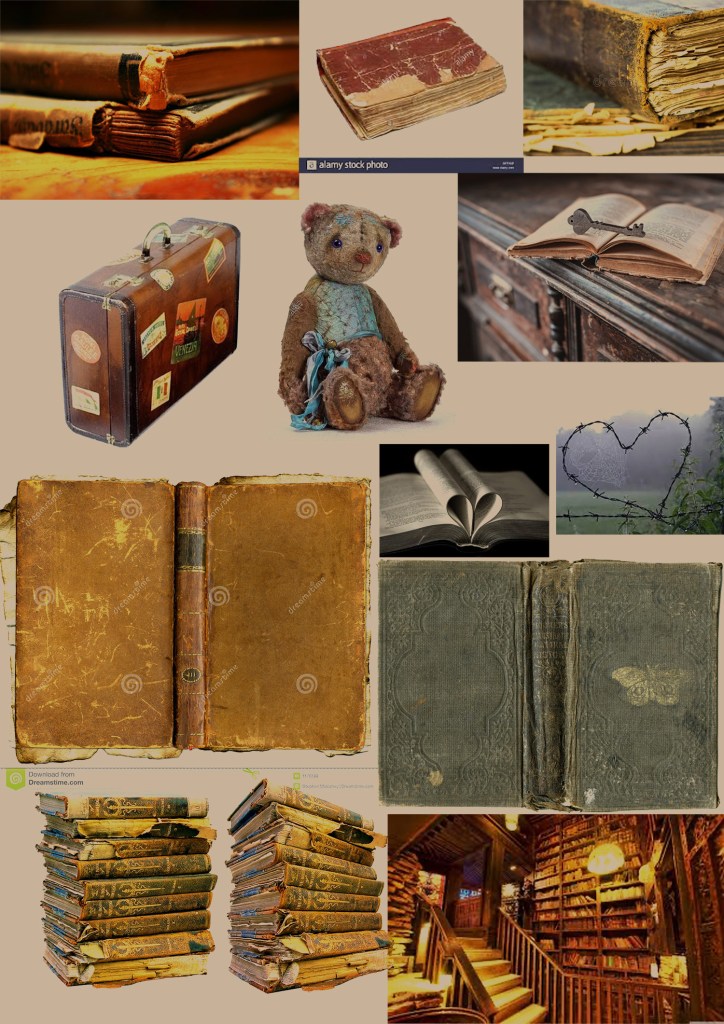
What I had in mind was something that looks old and tattered but still gives good value to the reader, or something that looks old, but in fact it carries new ideas. So basically going off on this idea, I wanted to do some secondary research to come up with some visuals that communicate this.
I hunted down some images that communicated my idea best and added them to a moodboard to inspire some further research.
I also went off to look at some less visual sources to see what the definition for this phrase.
I found the following page very insightful: https://www.theidioms.com/cant-judge-a-book-by-its-cover/
Meaning
- outward appearance cannot be an indicator of someone or something’s value or worth
- you cannot know what someone or something is like just by looking the person or thing’s appearance
- the quality or character of someone or something cannot be judged just by looking at them
- an opinion of someone or something cannot be formed solely by seeing what’s on the surface
Example Sentences
- The candidate did not look very intelligent, but you can’t judge a book by its cover.
- The hotel looked attractive from outside, but the rooms were damp and not well maintained. You can’t judge a book by its cover!
- Do not form opinions of a persons character by looking at his appearance. You can’t judge a book by its cover.
- At first we did not want to go into the restaurant as it looked small and cramped; but the food was delicious – we realized that you can’t judge a book by its cover.
- The car was small and looked unsuited for a long trip, but packed a lot of power and was very solid. You can’t judge a book by its cover.
- That man may look very small and insignificant, but don’t judge a book by its cover – he’s a very powerful man in his circle.
Source: theidioms.com
I also read the excerpt this phrase originates from George Eliot’s The Mill on the Floss. It is basically said by a character when they buy a bunch of books that are all bound in a very similar fashion, thus creating this idiom.
I wanted to develop the idea a bit further by thinking about what books this idea could be applied to. I was thinking that something that is presenting a newfound idea or topic that would was not prevalent in the past. This also made me think that this idea could be applied in the reverse way, present a very old idea in a modern looking book. I think this contrast will be key when it comes to communicating the idiom.
I started by looking at some very cutting edge topics that would have been unheard of in the past. I was doing some google searches for things like “Things that didn’t exist 100 years ago” and “Futuristic things”… this didn’t take me very far, but sparked a few ideas.
- AI technology
- Quantum Computing
- 5G
- 3D printing
- VR tech
- Cyber Warfare
Most of my ideas were technology related. I think they would work best with an old cover to have the desired effect.
On the flip side of things I was thinking of finding some really old antiquated ideas or topics that I could present in a very minimal and new way. I think this would have a similar effect, maybe I could present these side-by-side to take this contrast even further.
I was thinking that I could probably best mock an old looking book up using 3D software as the material is just as important as the design itself to be able to achieve the look I was after.
I have found a free 3D model that I could use as a basis for my design.

This was almost exactly what I had in mind in terms to the cover texture. I wanted to give it some ornate cover design similar to these below.
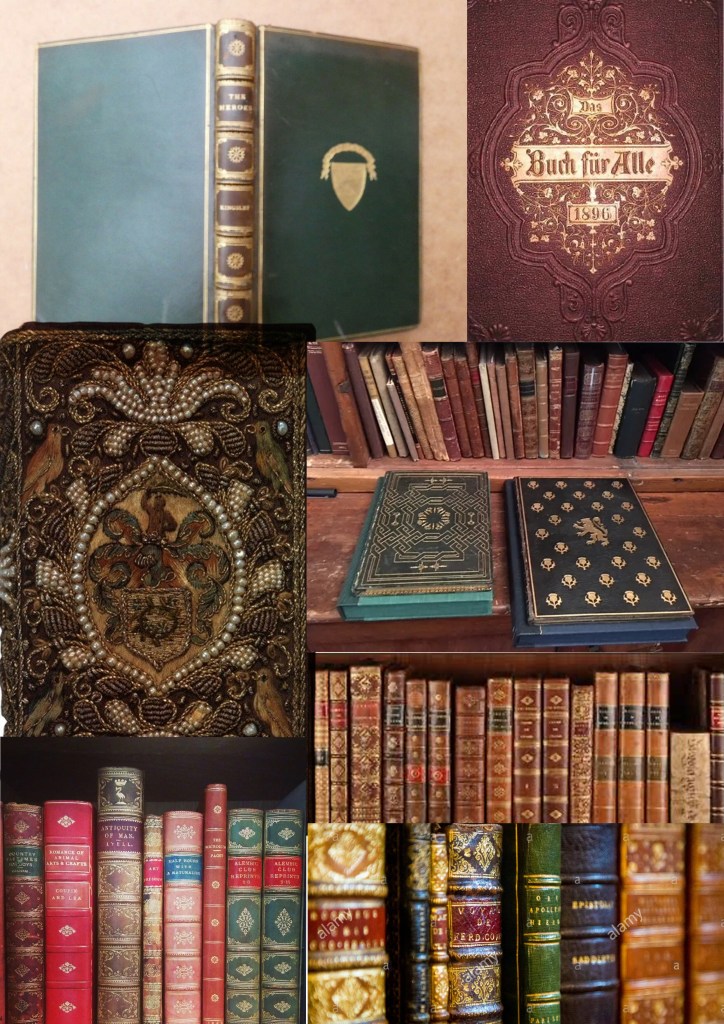
To start with, I wanted to experiment with some ornate patterns that were present on these covers and make them somewhat techy.
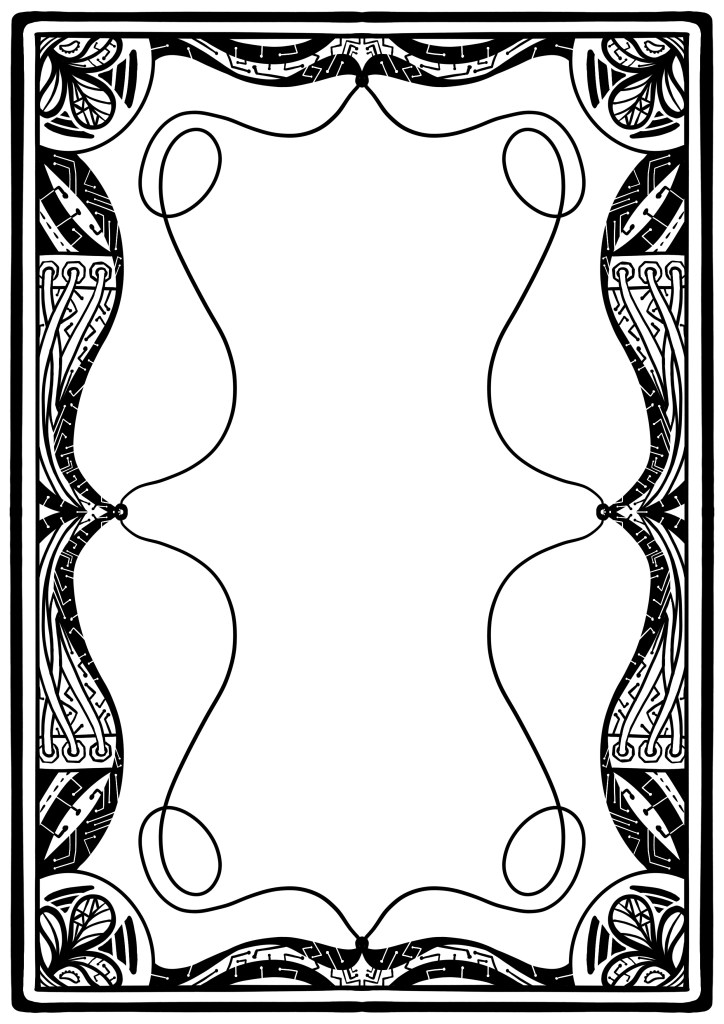
I created the below illustration on my iPad using the mirror canvas function in Procreate.
I wanted to make big swooping lines to make it similar to those fairly tale books and then I started adding some circuit board patterns to break it up a little. I think it started to come together quite nicely.
I added this to the 3d model to see how this looks. I quite liked the outcome.
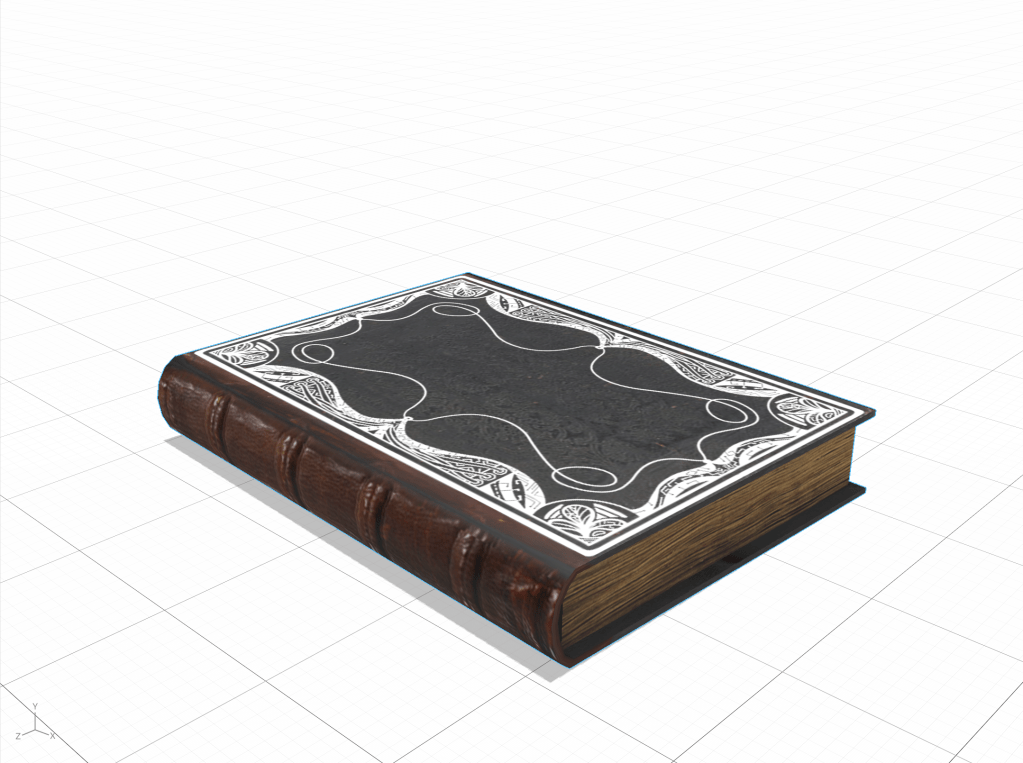
I ultimately wanted to insert this as a label into the programme and make it so it looks like shiny metal, that has faded over the years.
It was time to look at some options when it comes to the font that I would use for this sort of cover. I wanted something ornate to further emphasise the contrast between the cover and the topic of the book.
Wanted to use something like the below:

When I tried using some similar fonts I could find, I didn’t like the outcome so I went with a more handwritten font like I originally envisioned. I found a font with lots or ornate swooshes that I liked and I think will work for my cover.

I liked this because it was very ornate and delicate at the same time, exactly what I was after.
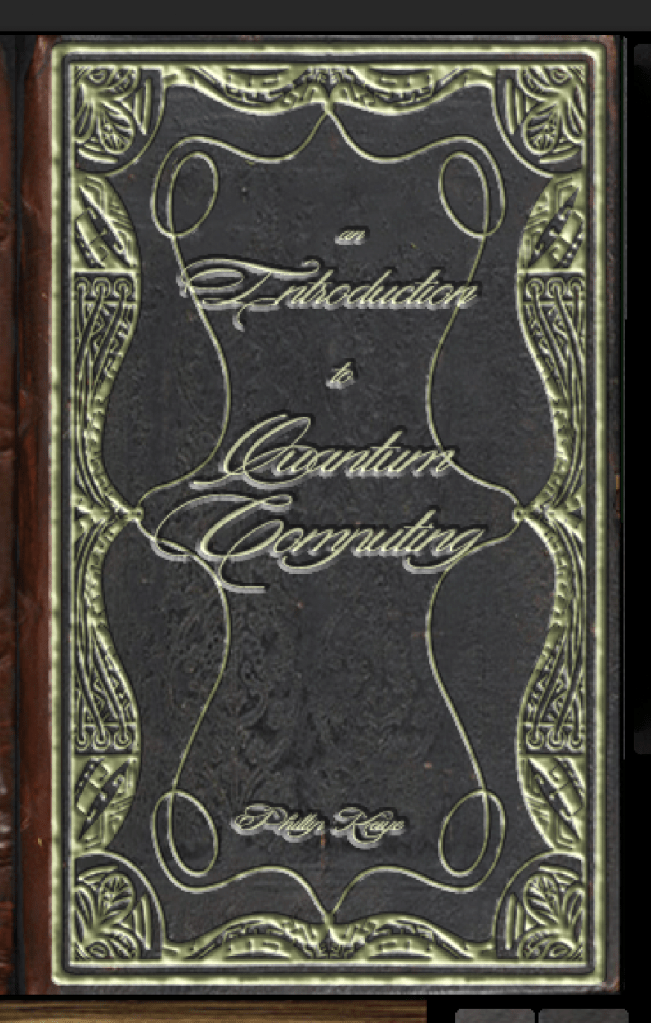
I really liked how this started to turn out. I imported it into my 3D software and made some adjustments to the layout to make things a little more readable.
Next I went and sourced an image for backdrop before I rendered my final image.
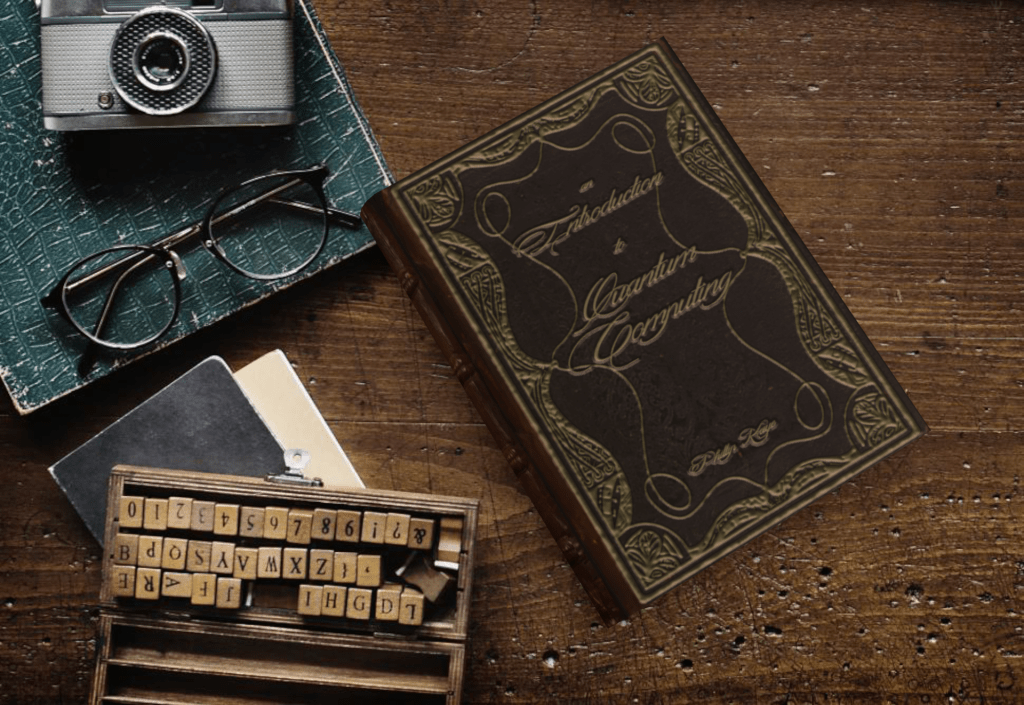
Having access to 3D software such as Adobe Dimension makes the process of creating a mockup a breeze. I have used this in previous projects and I am always very surprised how realistic the mockups turn out. I think this project showcased my understanding of the research and development stages a design needs to go through from the initial idea to the final product mockup.
 Graphic Design