Given the current development of the book from printed to digital technologies, what do you see as the future of the book, for readers, and book designers? Where do you see the book heading? Show and tell. Try and summarise your thinking into a series of short statements, quotations, images (collage) or ideas. Be creative in how you approach this. Use your learning log to reflect on the essay and your own thoughts and visual ideas about the future of book design. This research will feed into part of your first assignment.
OCA Book Design 1: Creative Book Design
Digital platform magic
I think the transition to digital platforms offers a unique opportunity to authors to present their ideas in ways previously not possible. Integrating visual media that makes the script come alive with images, videos and interactive elements that are just simply not possible in print. It also offers a unique opportunity for their ideas to reach a wider audience with better accessibility options. It is no longer necessary for the sight impaired readership to only choose from books that are available in an accessible format. I think this accessibility and feature richness makes the digital medium far superior to the printed counterparts.
So what makes people like physical books?
I think these are mostly sentimental reasons. It has something to do with liking to possess objects, feel them under our fingertips as we touch them and smell the ink and paper that forms this object. As I mentioned above there are many limitations to what a traditional book can contain, however there are so much that it can do that a digital counterpart simply cannot.
Some of the charm of books I think comes from the fact that they can tell a story beyond what is contained within their pages. A coffee stain on page 10, a scribble here, some missing pages there. This is not just true about pre-owned books however, some interesting effects that can be achieved with the different kinds of textures, papers and printing techniques that make owning a physical book a different kind of experience.
How could physical and digital books coexist?
I outlined above how I think both mediums have their strengths and weaknesses. I think any author who doesn’t consider doing both of the mediums would be loosing out on readership.
I think there are ways that the industry could go about harnessing the power of both mediums. I think publishing both digital and analog would enable publishers to offer 2 different kinds of experience for the same publication. The physical version could come bundled with the digital book as an extension to it, offering all of the extra features.
After reading the Introduction to book history – Finkelstein, D., & Mccleery, A. (2012) it has occurred to me that there are also other factors that divide the 2 mediums. The availability of technology which eBooks can be consumed through isn’t as widely available in developing countries, and therefore the physical book is the more conveniently available option. I have quite a skewed view on this topic as living in the UK I often forget that all the technology available to me may not be as widely spread in other countries.
So what could lie ahead for books?
I found a very interesting article on the topic on WIRED online. This article argued that the future of the book isn’t solely lying in its complete digitisation but in many different forms of publishing.
Print on demand publishing is a newfound industry that has been booming for the past decade or so. It enables authors to publish books cutting out all of the expenses associated with traditional publishing. Sure these self-published books won’t be directly competing with books of the large publishing houses but they enable authors to communicate their ideas to a niche market.
The article then goes on to argue that the newsletter email maybe the the future of how authors can connect with their audience most effectively as this creates a direct contact between the author and reader without the disruptions of social media and its algorithms.
Audiobooks have come a long way since the invention of the medium too since their genesis in 1969. We all have devices in our pockets that are capable of carrying a whole library of audiobooks and we can listen to them accross multiple devices thanks to the marvel of cloud syncing tech.
Crowd funding has also seen a massive uptick in the recent years which offers authors the platform to market their books before it has been printed raising the capital needed to create the books, this is also a good way to gather communities around a niche topic.
My illustration of the future of the book:
I created a collage to illustrate the future of the book
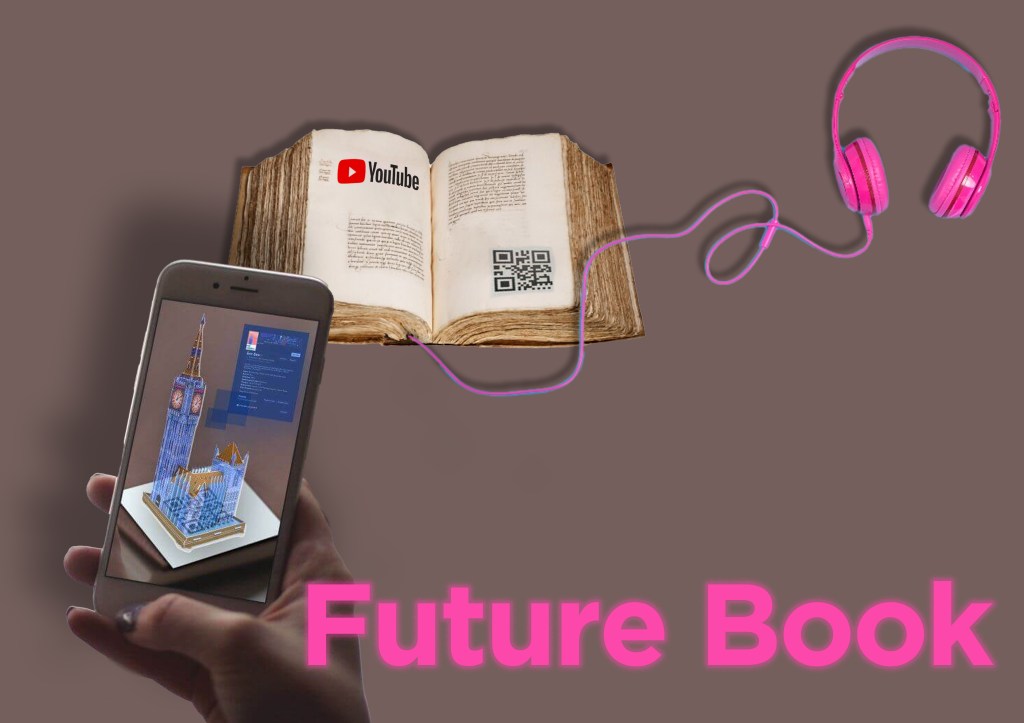
I don’t think it covers everything I learned in this part, however I think it illustrates the complexity of how the book as a medium might evolve in the future.
Image sources:
- https://www.smithsonianmag.com/smart-news/book-lost-books-was-discovered-danish-archive-180971943/
- https://www.youtube.com/howyoutubeworks/policies/community-guidelines/
- https://www.campaignlive.com/article/why-every-brand-needs-audio-marketing-strategy/1660238
- https://www.dogtownmedia.com/whats-next-augmented-reality-2018/
Conclusion
The future of the book I think lies not in one media or solution. All of the different formats available today have pros and cons, so only time will tell what medium will be the most prevalent in a hundred years. Until then we have the option to listen, read and experience these books easier than ever before, which is absolutely fantastic.
I think I learned from this research that the book is so much more than just a few pages bound together with words printed across them. They are a vehicle in which authors can communicate their ideas in a variety of forms to a wide array of audiences. I will bear this in mind when creating work for this module and hopefully this will let me consider more than just the printed page.
Sources:
https://www.wired.com/story/future-book-is-here-but-not-what-we-expected/
Introduction to book history – Finkelstein, D., & Mccleery, A. (2012)
 Graphic Design
One Comment Add yours