
Consider the importance of books to you both personally and within a broader global sense.
First of all, think back to the earliest books you came across as a child, through your teenage years and early adulthood to where you are now. There may be half a dozen books which stick in your memory or are important to you in some way. There may be many more than that. It may be an early reading book, a particular image or short rhyme which helped you recognise letterforms. It may be the distressed metallic silver cover of a Salinger novel you read as a teenager, or the book you bought on impulse after work one day, seduced by the tactile quality of the cover.
Identify these books in your learning log, use photographs and annotation to create an illustrated list documenting the books that are important to you, for whatever reason.
Now, connect your influential books to those with a more global reach. Identify seminal works that have informed or challenged some of the areas you have identified. These may be scientific, artistic, historical, political, geographic, fictional, poetic or religious texts. For example, a book from your childhood could connect to other seminal children’s books by association, such as Heinrich Hoffmann’s Der Struwwelpeter / Shockheaded Peter (1845) or Charles Perrault or the Brothers Grimm. Likewise a book featuring dinosaurs might connect to Charles Darwin’s Origin of the Species.
When we appreciate the breadth and influence of books, we begin to appreciate the extent of a book’s potential impact. Books carry and communicate ideas; powerful messages can be contained within seemingly innocuous bound paper pages. In your learning log, create another list of books, with accompanying images and annotations, which you believe to be more globally important, but connect to your first list in some way.
This activity will feed into your first assignment, so document your ideas in your sketchbooks and learning log to refer back to later.
OCA Book Design 1: Creative Book Design
I think this exercise will be quite a difficult one for me. I must admit that I have never been massively into books. I am a very visual person so I have always preferred consuming visual media such as films or images to books. I think this stems from the fact that I learnt to read to a basic level before starting school and being bored when I was supposed to learn. By the time my teachers and parents have realised what was going on, I was far behind and feel like I never caught up. I remember some incidents in school where I was made to read out loud and feeling embarrassed by how bad I was reading. As such, reading has always been a touchy topic for me, and I have never really enjoyed it.
That said even I have a couple books that I feel have had a massive influence on me. The earliest one I can properly remember was the Harry Potter series by J.K. Rowling. I think I started reading the series because it was so popular at the time that every school child had to have read them or risk being the outcast. Despite this, I think this was the period of my life when I read the most and have somewhat enjoyed it. I think I even joined the library.

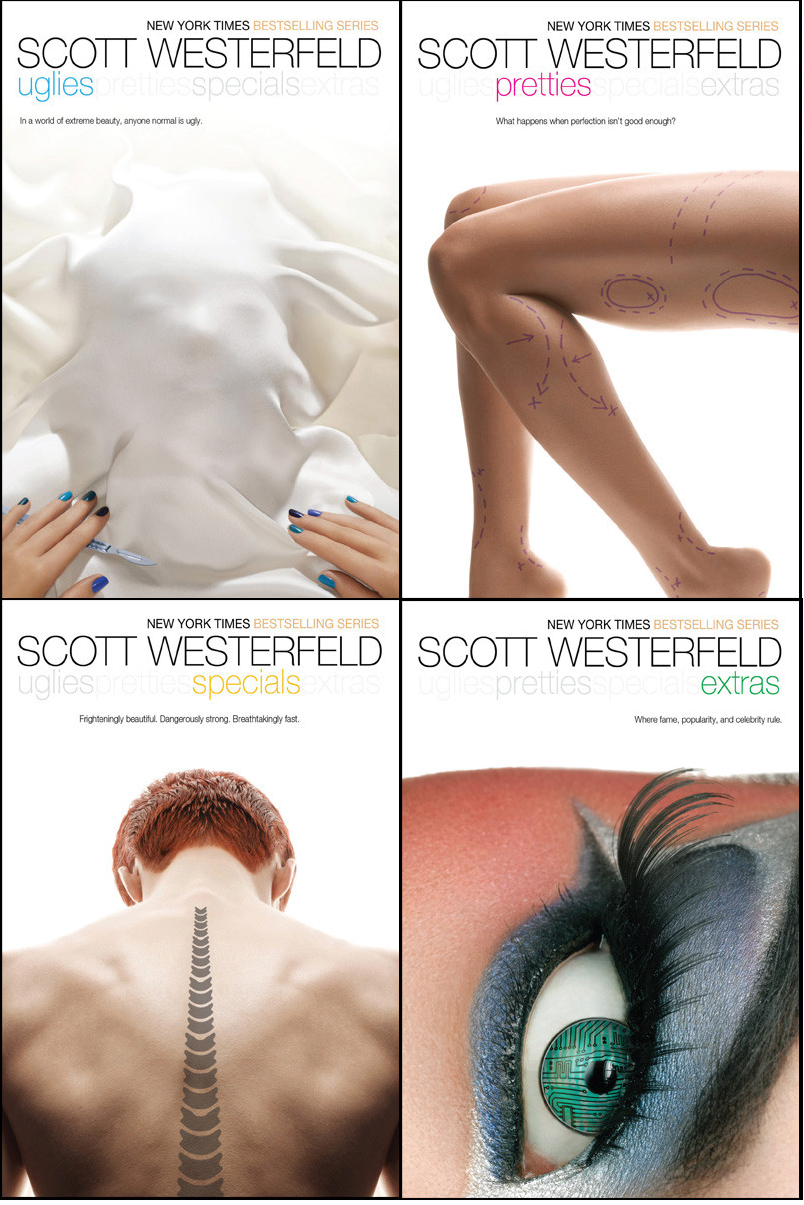
Another series of books I can remember reading is the Uglies by Scott Westerfeld. I cannot fully recall what made me pick up these books. I don’t think they were massively popular maybe I heard about the story and I felt like it was something that I would enjoy. I remember being very fond of these stories, and have actually re-read these since which is really rare for me. In terms of design these were very simple paperback books with s mostly white cover with imagery of plastic surgery on it. It was very simple, yet effective.
Since these books I don’t think I read anything substantial. For me reading serves a function of understanding rather than a form of entertainment, so this is pretty difficult.
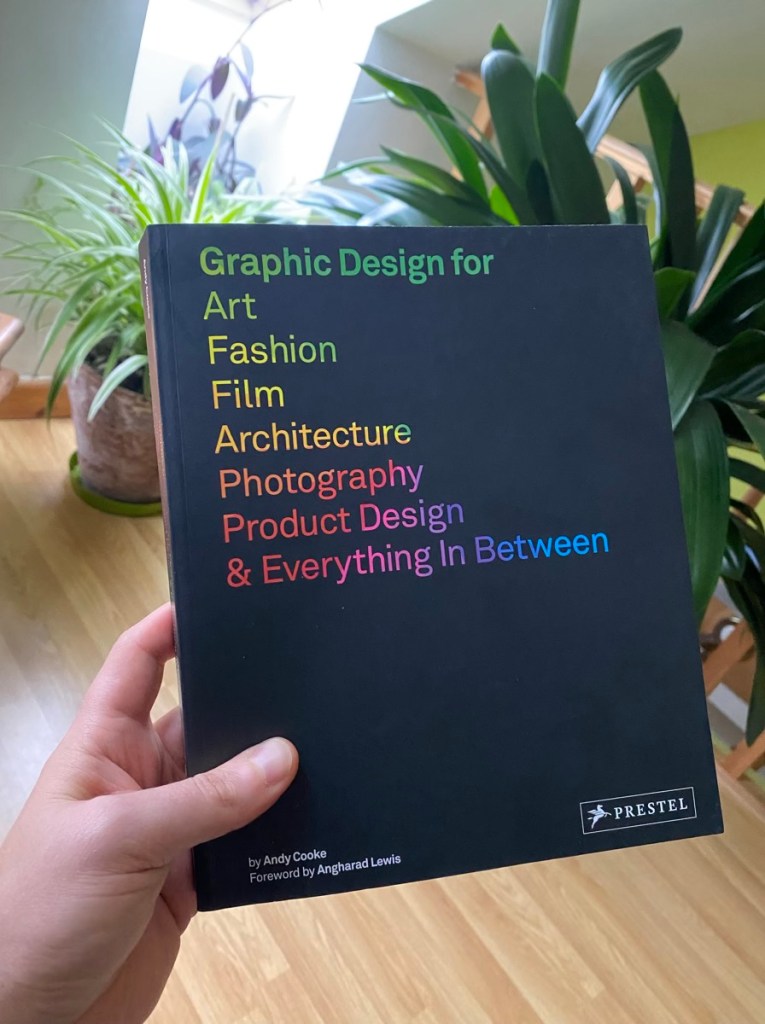
Once again I can mention the book I quite like by Andy Cooke, Graphic design for Art, Fashion, Film, Architecture, Photography, Product Design & Everything In Between. This book is mostly images so I can relate to this a lot more. I think the cover is great, as I mentioned in my initial introductinary blog post, the cover reminds me of an art technique I have used as a child.
When it comes to global influence, I would say there is probably not a single book/book series that had a bigger success or more influence on the world around us than the Harry Potter series. I think the fact that they grown into a multimedia franchise has definitely helped this, but it wouldn’t have been possible if the novels themselves have not captured the imagination of so many.
I found the below information about the cover designs:
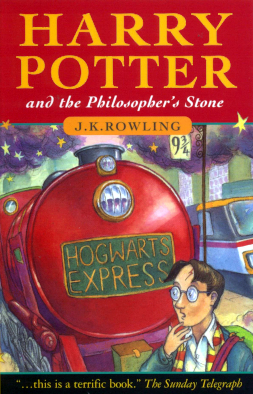
For cover art, Bloomsbury chose painted art in a classic style of design, with the first cover a watercolour and pencil drawing by illustrator Thomas Taylor showing Harry boarding the Hogwarts Express, and a title in the font Cochin Bold.[83] The first releases of the successive books in the series followed in the same style but somewhat more realistic, illustrating scenes from the books. These covers were created by first Cliff Wright and then Jason Cockroft.[84]
Due to the appeal of the books among an adult audience, Bloomsbury commissioned a second line of editions in an ‘adult’ style. These initially used black-and-white photographic art for the covers showing objects from the books (including a very American Hogwarts Express) without depicting people, but later shifted to partial colourisation with a picture of Slytherin’s locket on the cover of the final book.
International and later editions have been created by a range of designers, including Mary GrandPré for U.S. audiences and Mika Launis in Finland.[85][86] For a later American release, Kazu Kibuishi created covers in a somewhat anime-influenced style.[87][88]
Wikipedia Contributors (2019). Harry Potter. [online] Wikipedia. Available at: https://en.wikipedia.org/wiki/Harry_Potter.
The cultural influence of the franchise is also undoubted. It has been the source of inspiration for so many things it has even inspired some scientific names according to wikipedia.
The sport Quidditch, played by characters in the Harry Potter series, was created in 2005 and is played worldwide including at universities such as Harvard University, Yale University, and Washington University in St. Louis.[99][100][101][102] Characters and elements from the series have inspired scientific names of several organisms, including the dinosaur Dracorex hogwartsia, the spider Eriovixia gryffindori, the wasp Ampulex dementor, and the crab Harryplax severus.[103]
Wikipedia Contributors (2019). Harry Potter. [online] Wikipedia. Available at: https://en.wikipedia.org/wiki/Harry_Potter.
Conclusion
This exercise has helped me to realise that even though I am not a bookworm by any stretch of the imagination, I am too touched by the effects of books. They have a wider cultural influence than I cared to notice before and as such can be a very interesting platform to explore as a graphic designer. I think I need to keep an open mind in advance to realise my full potential for this unit.
 Graphic Design
One Comment Add yours