
Exercise: Turning words into pictures
Choose a word from the list and draw everything that comes to mind. Don’t be concerned about the accuracy of your drawing or the prettiness of it. Use your drawings as a form of visual shorthand. Have a broad range of materials to hand and during your visual brainstorm add swatches of colour and texture associated with your word. If the word sums up a scene try to deconstruct it into its constituent parts. Imagine you are moving around the scene with a camera and recording each element to create a visual checklist a catalogue of images.
OCA Key Steps in Illustration
Childhood, Wild, Exotic, Fashion, Destruction, Travel, Kitchen
Be conscious of the details and qualities of each subject or object you draw to communicate its qualities and function. Notice how you are developing a sense of visual editing and distillation of information. Adjectives are most difficult to draw. Be aware of the mental processes you undertake to generate subjects to draw in response to these less concrete words. Developing the ability to give tangible form of abstract concepts is important for illustration and is a skill that can be honed over time. Note how your drawing evolves when repeating this exercise. Can you see a flavour in the way that you are begin to document through these little drawings?
When I first looked at this exercise, I thought it will be super easy. Once I started drawing however, I found that gathering ideas this way can be challenging. I tried to think about all aspects of travel, and quickly jot down what came to mind.

What I observed with this, is that I did not think as laterally as before, because drawing some things definitely taken me longer than it would have to quickly jot down the word that came to mind. Although that was the case, I quite enjoyed this way of thinking and recording ideas.
I wanted to repeat this using one of the other words to see if I am more successful second time around.
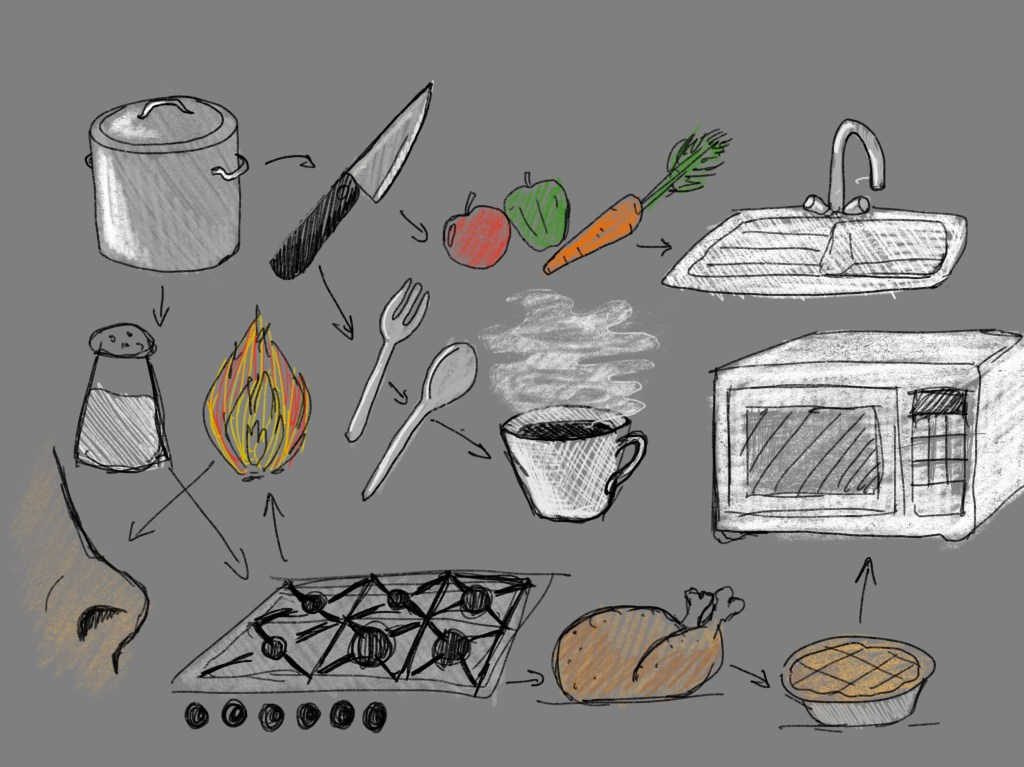
I think I need to loosen up with my drawings. These are still too perfect and definitely not showing everything that crosses my mind, because I am often forgetting what I was thinking about before I finished the previous drawing. The end result is very predictable and don’t think it would be helpful to me in generating ideas. I think probably the fact that I am only drawing the things that I know how, and the things that are often depicted in connection of the topic doesn’t help the process.
Reflection
I am not too sure if I am thinking too literally and hence this is limiting my ability to get good results with this, or perhaps the fact that I am trying too hard to make the drawings somewhat recognisable and this leads to spending too much time per individual element.
What I did find sort of useful is adding arrows between the different elements to indicate what came to mind after drawing a certain picture and so I can pick up the trail of thought and generate more ideas laterally. I think I need some practice with this to see if I can utilise this technique in my practice and get different results than from conventional spider diagrams.
Exercise: Making a moodboard
Choose one of the words from the previous exercise and on a large sheet begin
OCA Key Steps in Illustration
expanding on the themes and ideas that you identified.
Collect swatches of colour and texture to or create your own to establish a palette of colours and repertoire of marks. Google some of the words and from the Images link, either print off or draw from some of the images that emerge. Go through other books and magazines and take snippets of images, which have associations with your words and theme. Assemble these elements on your large sheet.
You are not creating a piece that is a designed artefact in its own right. You don’t have to include words but may want to selectively incorporate some words into your moodboards as an aide-memoire. If you organise your content according to visual connections you may find that links and some nice surprises emerge This should lead to you being able to recognise or establish a hierarchy within your content. There is more on this concept in Part three.
I chosen the word child hood as my starting point for this part of the exercise. I think this is something that brings lots of ideas to mind.
I started by picking some colours that I think work well for the theme. I wanted to make them bright and positive. After this I have looked at my cheat sheet (my spider diagram from a previous exercise and started finding images that I felt represent childhood. Some of these were of children playing and getting messy with paints, I liked this trail of thought, so I added some cartoony blotches in my chosen colour to represent this further. After this I was thinking about what happens when children play, they fall down and get grazed knees, so I added a photo representing this. I think it is important to show other sides of a topic as well.
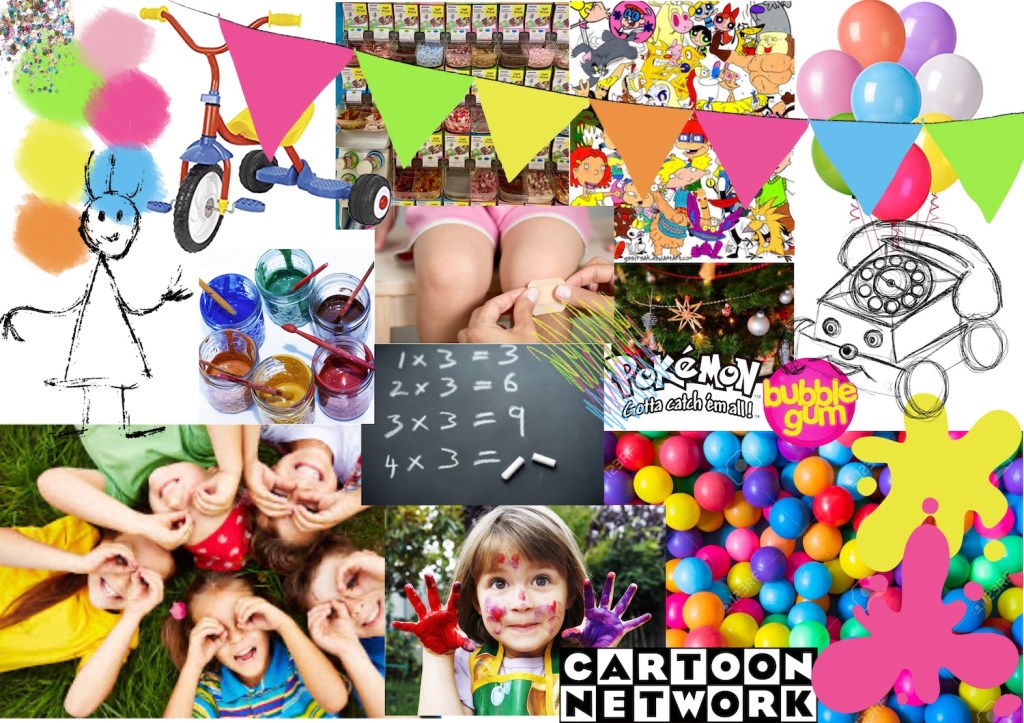
I think this was pretty successful. this is the first time that I created a moodboard that has more than just photographs and I think it worked out pretty well. I think whoever I would show this would know roughly the idea without giving them a full brief which is what a successful moodboard should achieve.
Reflection
I think this exercise was useful to show the next steps after coming up with keywords and concepts for a piece should be visual research that is done in a thorough but fluid way that is always open to new ideas. I think after having put together the above I would be able to come up with ideas for all of the topics and create some sort of illustration. I wouldn’t be stuck for ideas which is a creators worst nightmare. I think I will employ these techniques with more confidence going forward.
 Graphic Design